-
Hex the Mac color picker
-
handy tip for quick access to color picker, especially when combined with the HexColorPicker add-on
-
buy these geek shirts. !!! sudo buy these geek shirts.
-
There's a new version of SQL Server client tools that has better query integration (no more moving over to query analyzer). I'm still getting to know it, but so far I'm impressed.
-
a story about the dark side of ubiquitous computing by Bruce Sterling. "If 'religion is the opiate of the people', then immersive multiplayer 3D virtual worlds are hard-core Afghani heroin."
-
many, many great talks here about long term thinking. you can subscribe to the podcast, or watch many of the talks at Google Video
-
interesting thoughts on structured data vs. conversations in a world with fantastic full-text search + tagging. Will conversations win?
-
open source data destruction. useful if you want to sell/donate a computer or hard drive.
-
some cities are starting to use Google Earth to model for planning. (via slashdot)
-
Big carbon credits: "Branson...said the money would come from 100 percent of the profits generated by his transportation sectors -- trains and airline companies." (via kottke)
-
nice flickr interface
-
"But simply by enhancing my ability to google, this guide -- now in a meaty third edition -- is worth the price. It's the Missing Manual to Google." - Kevin Kelly
-
Jason's vacation photos from Austria are great.
-
This is a colorful headline from The Money Times. They could have had a trifecta by working in the phrase "thin blue line".
-
Climatologist James Lovelock: "Our global furnace is out of control. By 2020, 2025, you will be able to sail a sailboat to the North Pole. The Amazon will become a desert, and the forests of Siberia will burn and release more methane..."
-
Google's Flickr competitor (via nelson)
-
tips for tuning your site for Google, culled from googler Matt Cutts' blog.
-
I hadn't thought of the "visited" CSS class as a security problem before, but this phishing technique is pretty clever (and evil). (via joshua)
Amazon Adds Comments
Just noticed that Amazon is now allowing comments on each review. It looks like this:
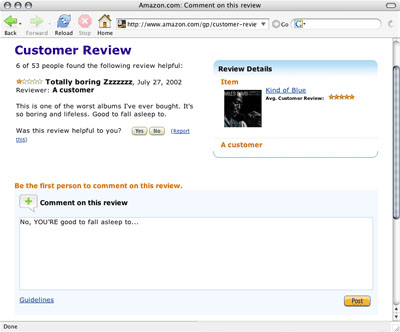
For years, Amazon has tried to keep people from having conversations via reviews with careful instructions about not referencing other reviews. But that didn't stop people from conversing. You often see things like, "Reviewer x is off his rocker..." or "I don't know what some of these reviewers are thinking..." in Amazon reviews. Now people can talk to each other directly.
If people know that their reviews are "thread starters" rather than isolated posts, you could get more chatty reviews with open-ended questions designed to provoke discussion. You should also get more flame wars, more trolling, all of the standard online discussion problems. (Especially with an audience as large as Amazon's.) And how do you police comments on millions of reviews? Does each reviewer "own" the thread associated with the review? If so, shouldn't they be able to approve/edit comments on that review? Is it fair to allow comments on a review from six years ago, when the author of that review isn't expecting feedback, and likely isn't tuning into the page anymore?
On the positive side, you might get a better view of a product because discussion can bring out more detail. Should be interesting.
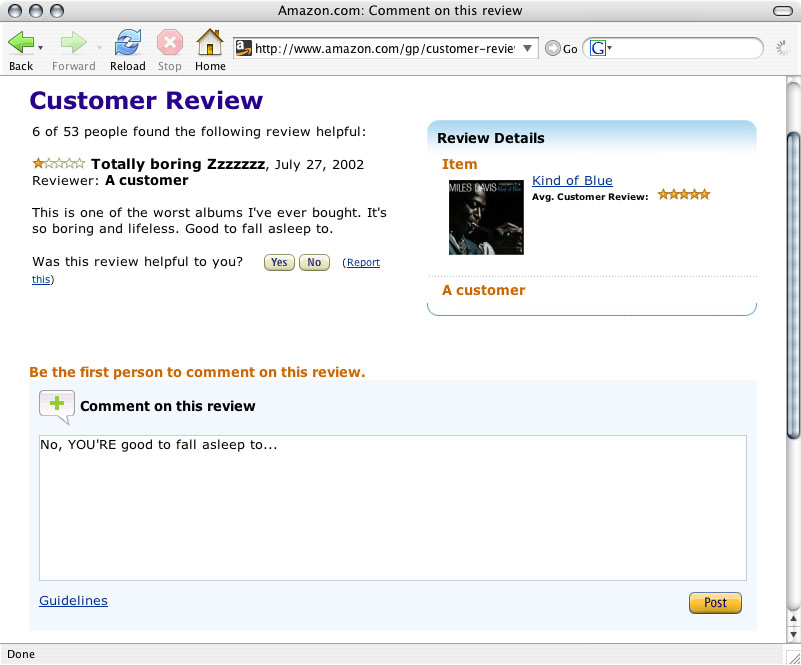
(click to enlarge)
For years, Amazon has tried to keep people from having conversations via reviews with careful instructions about not referencing other reviews. But that didn't stop people from conversing. You often see things like, "Reviewer x is off his rocker..." or "I don't know what some of these reviewers are thinking..." in Amazon reviews. Now people can talk to each other directly.
If people know that their reviews are "thread starters" rather than isolated posts, you could get more chatty reviews with open-ended questions designed to provoke discussion. You should also get more flame wars, more trolling, all of the standard online discussion problems. (Especially with an audience as large as Amazon's.) And how do you police comments on millions of reviews? Does each reviewer "own" the thread associated with the review? If so, shouldn't they be able to approve/edit comments on that review? Is it fair to allow comments on a review from six years ago, when the author of that review isn't expecting feedback, and likely isn't tuning into the page anymore?
On the positive side, you might get a better view of a product because discussion can bring out more detail. Should be interesting.
-
a bunch of useful web services, and some wacky services like detecting nudity in a photo. (via waxy)
-
good tips for speeding up Windows boot times
-
tons of data visualization ideas in one place. (also mentioned in Cal's talk.)
-
Cal's talk at fowa mentioned copious graphing for web ops. This was one of the tools he mentioned.
-
wikipedia article that includes Kollock's motivations for online contributions.
-
Mobile photography software from Yahoo. The auto-tagging is clumsy, but the tag-suggestion based on location looks nice.
-
Types of players in old-school MUDs--translates well to web application users.
-
Project Gutenberg: "This volume is a narrative of Scott's Last Expedition from its departure from England in 1910 to its return to New Zealand in 1913."
-
Holovaty.com advises newspapers to move from story-factories to databases